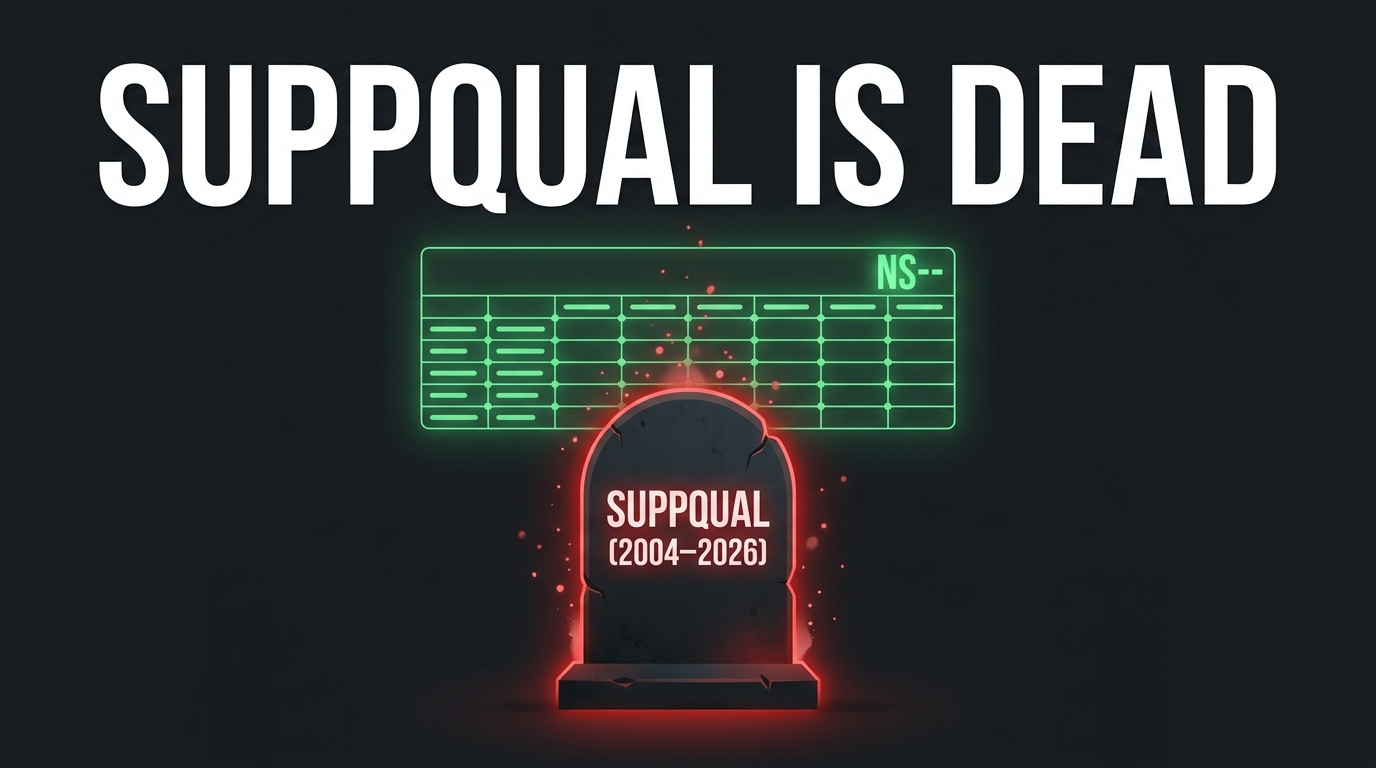
sdtm validation rstats sas clinicaltrials cdisc automation The SUPPQUAL Sunset: Re-architecting Legacy Mapping Pipelines for SDTMIG v4.0 Non-Standard Variables (NSVs) July 20, 2026 ClinPilot Insights If you have spent more than a week working as a statistical programmer, you have probably cursed the existence of Supplemental Qualifier (SUPPQUAL) datasets. Since the birth of SDTM, standardizing any variable that fell outside the CDISC general observation class domains meant dumping it into a vertical, key-value repository. It was a structural compromise that allowed the standard to stay rigid while clinical trials evolved. But the cost was high. It made ADaM derivation pipelines bloated, error-prone, and painfully slow. With the release of SDTM v3.0 and SDTMIG v4.0, CDISC is finally sunsetting SUPPQUAL datasets. In their place, we get Non-Standard Variables (NSVs) housed in a clean, horizontal dataset structure (`NS--`). It is a massive improvement. But if your organization has spent the last fifteen years building global automation macros around vertical SUPP files, you have a lot of re-architecting to do. ## The Vertical Hell of SUPPQUAL To understand why the new model is such a relief, we have to look at the mess we are leaving behind. Under the legacy SUPPQUAL model (e.g., `SUPPAE`, `SUPPLB`), non-standard variables were mapped vertically using three core columns: `QNAM` (the variable name), `QLABEL` (the variable label), and `QVAL` (the value). This approach forced three major technical bottlenecks: 1. **The Character Cast Constraint:** `QVAL` is strictly a character variable. If you had a numeric clinical score, you had to format it as a string to put it in `SUPP`. In ADaM, you then had to convert it back to numeric, crossing your fingers that no one typed "O" instead of "0". 2. **The Transpose Tax:** You could not simply join a SUPP dataset back to its parent. You had to sort, transpose (`proc transpose` in SAS or `pivot_wider` in R), and then merge. 3. **The Numeric-to-Character Identifier Match:** The parent key identifier variable (`IDVARVAL`) was always character. To join `SUPPAE` back to `AE` on `AESEQ`, you had to convert the numeric sequence variable to character to write the SUPP, and then convert it back to numeric during the ADaM merge. Every single study required writing, testing, and running identical transpose macros. It was a waste of processing power and programmer sanity. ## Enter SDTMIG v4.0: The Horizontal NS-- Domain The transition to SDTMIG v4.0 replaces the vertical `SUPP--` structure with horizontal `NS--` datasets (e.g., `NSAE`, `NSLB`, `NSEX`). Instead of storing one row per non-standard variable, the `NS--` dataset stores exactly **one row per parent observation**, with each non-standard variable represented as its own native column. Here is what changes: * **Native Data Types:** Non-standard variables can now be natively stored as numeric or character. No more useless string casting. * **Numeric Joins:** The parent sequence variable is represented directly in `IDVARVLN` (numeric), matching the parent domain's numeric sequence variable (`--SEQ`) perfectly. * **No Transposing:** You do not need to pivot or transpose anything. You perform a straightforward 1:1 join. ### Code Comparison: Merging Supplemental Data Let's look at how much simpler our lives get. Here is the classic, ugly SAS programming pattern we had to use for fifteen years just to get a non-standard severity grade (`AESEVGR`) and treatment requirement indicator (`AETRTREQ`) back onto our Adverse Events dataset: ```sas /* ================================================================= */ /* THE LEGACY WAY: Transposing SUPPAE */ /* ================================================================= */ /* 1. Subset and convert character IDVARVAL to numeric AESEQ */ data suppae_prep; set sdtm.suppae(where=(qnam in ('AESEVGR', 'AETRTREQ'))); if idvar = 'AESEQ' and idvarval /= ''; aeseq = input(strip(idvarval), best8.); run; /* 2. Sort before transpose */ proc sort data=suppae_prep; by studyid usubjid aeseq; run; /* 3. Transpose the vertical data to horizontal */ proc transpose data=suppae_prep out=suppae_trans(drop=_name_ _label_); by studyid usubjid aeseq; id qnam; var qval; run; /* 4. Merge back to parent and convert character variables to numeric */ data ae_complete_legacy; merge sdtm.ae(in=a) suppae_trans; by studyid usubjid aeseq; if a; /* Manual type-casting for analysis */ if aesevgr /= '' then aesevgrn = input(aesevgr, best8.); run; ``` Now, look at the SDTMIG v4.0 horizontal equivalent. Because `NSAE` is already horizontal and uses `IDVARVLN` as a native numeric match to `AESEQ`, the entire transpose pipeline disappears: ```sas /* ================================================================= */ /* THE MODERN WAY: Simple 1:1 join on NSAE */ /* ================================================================= */ proc sql; create table ae_complete_modern as select a.*, b.AESEVGR, /* This is now a native numeric column! */ b.AETRTREQ /* Native character column */ from target.ae as a left join target.nsae as b on a.studyid = b.studyid and a.usubjid = b.usubjid and a.aeseq = b.idvarvln; quit; ``` The R equivalent in your modern ADaM pipeline is equally elegant: ```r library(dplyr) # Standard horizontal join in R tidyverse ae_complete <- left_join( sdtm_ae, sdtm_nsae %>% select(STUDYID, USUBJID, AESEQ = IDVARVLN, AESEVGR, AETRTREQ), by = c("STUDYID", "USUBJID", "AESEQ") ) ``` ## Re-architecting Your Core Automation Macros If your biometrics department relies on automated utility macros to generate and validate SDTM datasets, SDTMIG v4.0 represents a breaking change. Your legacy `%MAKE_SUPP` macros are obsolete. If you try to feed v4.0 data structures through them, your pipelines will crash. When planning your migration to v4.0, you must rebuild your standard templates: 1. **Decouple the Metadata Extraction:** Your mapping engine must distinguish between general observation class variables and NSVs during the metadata specification phase. 2. **Re-write the Dataset Builder:** Instead of routing non-standard variables to a single, vertical compilation dataset, your mapping engine must dynamically generate a parallel `NS--` table for each parent domain that contains custom variables. 3. **Establish Naming Standards:** Because NSVs are now actual dataset columns, you must enforce global variable registries. Under the old system, duplicate `QNAM` names across domains were easily ignored. Under the new model, naming collisions will break downstream data merges. ## Simplification of Define-XML v2.1 Metadata The sunset of SUPPQUAL has a massive, positive side-effect: it makes your Define-XML generation significantly easier. In previous versions of Define-XML, representing supplemental qualifiers required defining Value-Level Metadata (VLM) for the single `QVAL` variable based on the value of `QNAM`. Your define generator had to build complex, nested `WhereClause` conditions for every single custom variable in your study. Under SDTMIG v4.0, because `NS--` variables are true columns, they are represented directly as standard variable definitions. No VLM, no recursive where-clauses, and no custom lookups. They behave exactly like standard domain variables in your Define-XML specifications. ## Conformance Validation in 2026 The transition will not happen overnight, and FDA / PMDA regulatory catalogs will support both legacy and v4.0 standards for a multi-year transition window. When configuring your Pinnacle 21 or CDISC CORE validation setups for SDTMIG v4.0, ensure your validation engines are explicitly set to the new model configurations. Running legacy validation rules on v4.0 datasets will result in thousands of false-positive errors, such as flags complaining about the absence of required `SUPP--` files or flags warning that your custom variables do not exist in the standard model. Let your downstream medical reviewers know what is happening. They are used to seeing `SUPPAE` or `SUPPLB` in their review portals. A short note in your Reviewer's Guide (SDRG) pointing out that custom variables are now directly accessible as native columns in the horizontal `NS--` datasets will save you from answering a dozen unnecessary review queries. Recommended Insights sdtm define-xml validation Stop Hand-Coding VLM: Compile CDISC Dataset Specializations into Study Metadata Compile CDISC Dataset Specializations into governed study VLM before test codes, units, origins, and codelists drift apart. Jul 28, 2026 Read More sdtm clinicalprogramming sas RELREC That Reviewers Can Follow: Linking PR, TU, TR, and RS for RECIST 1.1 Build reviewer-readable links across scans, lesions, measurements, and RECIST 1.1 responses without relying on dates or sequence numbers. Jul 28, 2026 Read More
sdtm define-xml validation Stop Hand-Coding VLM: Compile CDISC Dataset Specializations into Study Metadata Compile CDISC Dataset Specializations into governed study VLM before test codes, units, origins, and codelists drift apart. Jul 28, 2026 Read More
sdtm clinicalprogramming sas RELREC That Reviewers Can Follow: Linking PR, TU, TR, and RS for RECIST 1.1 Build reviewer-readable links across scans, lesions, measurements, and RECIST 1.1 responses without relying on dates or sequence numbers. Jul 28, 2026 Read More